How Harm Reduction Saves Lives: Dr. Tom Reach on Reducing Stigma in the Treatment of Substance Use Disorders

Dr. Reach
Date Published 5/11/2026
Table of Contents
Dr. Ralph Thomas Reach, MD—known to colleagues and patients as Dr. Tom Reach, or simply Dr. Tom—is a physician trained in Addiction Medicine and Family Medicine with decades of experience treating substance use disorders.
Harm reduction is one of the most misunderstood ideas in addiction medicine. In recovery circles, it can be a frighteningly polarizing subject. Some people advocate for harm reduction policies such as Narcan access, sterile needle programs, testing for transmissible diseases, and safe places for people to seek help. Others argue that these efforts “enable” drug use or make substance use disorder worse.
But harm reduction should not be a right-left issue. It is a public health issue, and in many cases, it is the difference between people living and dying. In the work I do in my practice in Asheville and the greater Western North Carolina area with opioid dependence treatment, fentanyl addiction treatment, and substance use disorders, the first priority is simple: keep people alive long enough for help, healing, and recovery to remain possible.
In This Article You Will Learn:
- Why harm reduction is not a new or radical idea, but a familiar principle used throughout public safety and healthcare.
- Why keeping people alive must come before every other goal in addiction treatment and recovery.
- How practical harm reduction tools such as Narcan, sterile supplies, testing, and safer-use principles can reduce death, disease, and catastrophic medical consequences.
- Where to find reliable harm reduction and recovery resources for individuals and families.
What does harm reduction really mean?
Harm reduction means taking practical steps to reduce the negative consequences of drug use, especially overdose, infectious disease, injury, and death. The CDC describes harm reduction as a public health approach focused on reducing the harmful consequences of drug use while connecting people to treatment and other resources.
That definition matters because harm reduction is often misunderstood. It is not the same thing as saying drug use is good. It is not a substitute for treatment. It is not a denial that substance use disorders can destroy lives, families, and communities. Harm reduction is what we do when we acknowledge reality: some people are actively using drugs right now, and unless they stay alive, every other hope we have for them ends.
In that sense, harm reduction belongs beside treatment, recovery support, medically assisted detox, counseling, peer support, 12-step programs, and long-term care. It is part of a broader continuum. In our practice in Asheville and Western North Carolina, we do not see harm reduction as the opposite of recovery. We see it as one of the bridges that may help a person live long enough to explore the various avenues that could lead to long-term recovery.
The simplest way to say it is this: dead people do not recover. If a person is alive, there is still hope for treatment, family restoration, obtaining an education, having a stable job, and rediscovering one’s faith—in short, a meaningful and happy life. Conversely, if a person is dead, the conversation is over.
Why does harm reduction save lives and reduce catastrophic consequences?
The first goal of harm reduction is simple: keep people alive.
That may sound obvious, but in addiction medicine it has to be said plainly. A person who is actively using drugs is not going to get clean and sober, repair his family, find meaningful work, return to church, enter treatment, work the 12 steps, or build a new life if he is dead. If we lose him to overdose, infection, or brain injury, then all of our higher hopes for him are gone.
This is not a small problem affecting a handful of people somewhere else. In 2023, SAMHSA estimated that 48.5 million Americans aged 12 or older had a substance use disorder in the past year. The CDC reported that 79,384 people died from drug overdoses in the United States in 2024. That number was lower than the year before, which is encouraging, but it is still a staggering loss of human life. Behind every number is a son, daughter, father, mother, friend, or neighbor.
So when I talk about harm reduction, I am not talking about some abstract political slogan. I am talking about keeping Narcan available. I am talking about teaching people never to use alone. I am talking about encouraging a test dose. I am talking about sterile supplies, proper needle disposal, HIV and hepatitis C testing, and helping people stay connected to medical care instead of leaving them out on the street until something terrible happens.
And the evidence matters here. The CDC has reported that syringe services programs are associated with about a 50% reduction in HIV and hepatitis C incidence, and that decades of research show comprehensive programs are safe, effective, and cost-saving. The CDC also notes that these programs do not increase illegal drug use or crime. That last point matters because one of the oldest objections to harm reduction is the claim that it makes the problem worse. The evidence does not support that claim.
Harm reduction also reduces catastrophic medical consequences. If we can keep contaminated needles out of people’s arms, we can reduce the risk of bacterial endocarditis, hepatitis C, HIV, abscesses, sepsis, overdose, permanent brain injury, and prolonged hospitalization. That is not sentimentalism. That is basic public health.
It is also basic arithmetic. Treating HIV is expensive. Treating hepatitis C is expensive. Open-heart surgery for bacterial endocarditis is extraordinarily expensive. Long-term care for someone who survives an overdose with permanent brain damage can continue for years. Much of that cost eventually falls on hospitals, emergency services, Medicaid, local governments, law enforcement, jails, and taxpayers.
So even for the person who is not moved by the moral argument, there is a practical argument that should be impossible to ignore. Harm reduction saves lives, and it also reduces the burden on the healthcare system and public services. The most cost-effective long-term answer is to treat substance use disorders with appropriate medical care, including medications when indicated. But while we are trying to get people into treatment, we should not allow them to die from preventable causes.
That is why I have changed my mind on this issue over the years. Fifteen years ago, I would not have advocated for all of these measures. But after seeing the destruction caused by outdated thinking, stigma, and a failure to treat addiction like the disease that it is, I have changed my tune. Harm reduction is not giving up on people. It is refusing to give up on them before they have a chance to recover.
Where do we go from here?

If harm reduction begins with keeping people alive, then the next step is making sure they are not left there. Narcan, sterile supplies, testing, and safer-use principles are not the finish line. They are the doorway. They help keep a person alive long enough to consider treatment, reconnect with family, receive medical care, enter recovery, and begin building a different kind of life.
That distinction matters. Supporting harm reduction does not mean we are indifferent to drug use. It does not mean we have lowered our expectations for people with substance use disorders. It means we understand the order of things. First, keep people alive. Then help them find treatment. Then walk with them toward recovery, stability, restoration, and purpose.
In my practice in Asheville and the greater Western North Carolina area, I have seen what happens when people are treated as human beings rather than hopeless cases. Once a person survives, the next step is not one-size-fits-all. The path forward may be medical, social, spiritual, practical, or some combination of all of these. But none of those doors can open if a person dies before help reaches them.
That is why harm reduction should not be dismissed as a political slogan or a soft response to a hard problem. It is a practical, compassionate, and medically sound response to a disease that is taking lives every day. We can argue about policy, funding, and programs, but we should not argue about whether human beings are worth saving.
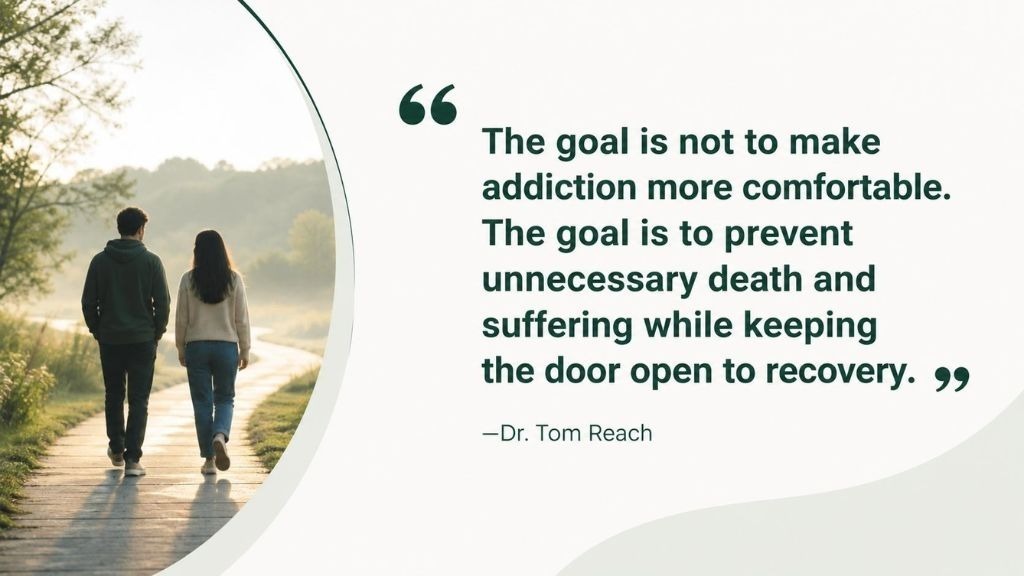
The goal is not to make addiction more comfortable. The goal is to prevent unnecessary death and suffering while keeping the door open to recovery. Harm reduction is not the opposite of recovery. Done rightly, it is one of the first steps that may make recovery possible.
About the Author
Dr. Ralph Thomas Reach, MD—known to his patients as Dr. Tom Reach—is a physician trained in Addiction Medicine and Family Medicine with decades of experience treating substance use disorders. A graduate of the University of South Carolina School of Medicine, he practiced emergency medicine for over 20 years in Central Appalachia and is trained in addiction medicine. Dr. Reach is licensed in North Carolina and focuses on providing comprehensive care, including Suboxone treatment, for individuals seeking recovery.
Read Dr. Reach’s full bio here: Provider Dr. Tom Reach | President & Founder
https://reachrecoveryhope.com/provider-dr-tom-reach/
Sources & Resources
Local and State Resources
Reach Recovery and Integrated Health
If you or someone you love is struggling with opioid dependence, fentanyl addiction, or another substance use disorder, Reach Recovery and Integrated Health offers compassionate, evidence-based care in Asheville and Western North Carolina.
URL: https://reachrecoveryhope.com/
Buncombe County Harm Reduction Services
Buncombe County provides harm reduction services and information intended to help prevent overdose, reduce infectious disease transmission, and connect people with care.
URL: https://www.buncombenc.gov/235/Harm-Reduction-Services
The Steady Collective
The Steady Collective provides free and confidential harm reduction services in the Asheville area, including naloxone distribution, syringe exchange services, wound care, and related support.
URL: https://www.thesteadycollective.org/
The Steady Collective Resources Page
This page includes outreach locations and service information for Asheville, West Asheville, Candler, and surrounding areas.
URL: https://www.thesteadycollective.org/resources
North Carolina Department of Health and Human Services: Syringe and Naloxone Access
NCDHHS provides statewide information about syringe services programs, naloxone access, and the North Carolina Safer Syringe Initiative.
URL: https://www.ncdhhs.gov/about/department-initiatives/overdose-epidemic/syringe-and-naloxone-access
Naloxone Saves NC: Where Can I Get Naloxone?
This North Carolina resource helps individuals find naloxone through pharmacies, local health departments, syringe services programs, and other access points.
URL: https://naloxonesaves-nc.org/where-can-i-get-naloxone/
SAMHSA National Helpline
Provides free, confidential, 24/7 treatment referral and information services for individuals and families facing mental health or substance use disorders.
URL: https://www.samhsa.gov/find-help/helplines/national-helpline
Research References
Centers for Disease Control and Prevention: Overdose Data to Action — Prevention Strategies
This CDC page defines harm reduction as a public health approach focused on reducing the harmful consequences of drug use, including overdose and infectious disease transmission, while connecting people to treatment and other resources.
URL: https://www.cdc.gov/overdose-prevention/php/od2a/prevention.html
Centers for Disease Control and Prevention: Strengthening Syringe Services Programs
The CDC states that syringe services programs are associated with an estimated 50% reduction in HIV and hepatitis C incidence, are safe and cost-saving, and do not increase illegal drug use or crime.
URL: https://www.cdc.gov/hepatitis-syringe-services/php/about/index.html
SAMHSA: 2023 National Survey on Drug Use and Health
SAMHSA reported that in 2023, 48.5 million people aged 12 or older had a substance use disorder in the past year.
CDC / National Center for Health Statistics: Drug Overdose Deaths in the United States, 2023–2024
The CDC reported that 79,384 drug overdose deaths occurred in the United States in 2024.