Want to Change Your Life? Train Your Brain to Do It
Staff
Date Published: 8/24/2026
Table of Contents
How neuroplasticity and neural repatterning can help you break old patterns and build healthier ones
Have you ever promised yourself, “I am not going to do this anymore,” only to find yourself doing it again? Maybe it started as recreational fun with friends, or a way to cope with discomfort, anxiety, or just not feeling comfortable in your own skin. Now, whether it’s spending hours watching pornography, losing evenings to video games, overeating, smoking, drinking, or using other substances, the pattern is similar. You know it’s not serving you, yet you keep returning to it. When a pattern has been repeated long enough, it can feel like you’re fighting your own brain.
In a sense, you are—but that doesn’t mean you’re powerless. The human brain remains capable of changing in response to experience, learning, and repeated behavior, a capacity known as neuroplasticity. Connections between brain cells can strengthen, weaken, and reorganize, and processes including synaptic pruning help shape neural circuits. These mechanisms are far more complicated than simply “deleting” bad habits, but they help explain why familiar behaviors—including patterns involved in substance use disorder and various other behaviors often labeled as “addictions”—can become so difficult to interrupt. They also give us reason for hope: the same brain capable of learning an unhealthy pattern remains capable of learning something different.
In This Article, You Will Learn
- Why you keep returning to behaviors you genuinely want to stop
- How neuroplasticity allows the brain to change
- How repetition, reward, dopamine, and expectations influence behavior
- What synaptic pruning does—and does not—mean
- How neural repatterning can help interrupt an established response
- Practical ways to begin strengthening healthier patterns
- Why support, treatment, and community may matter as much as determination
- Why patience and self-compassion are important parts of lasting change
Why Do I Keep Doing Things I Don't Want to Do?
Knowing that something is harmful and automatically stopping it are two very different things.
The brain learns from repetition. A stressful event, uncomfortable emotion, environment, or other cue can become linked with a particular response. If that response provides relief, distraction, stimulation, or reward, the brain has another reason to remember it.
With enough repetition, the sequence can become increasingly familiar:
Trigger → emotion or urge → familiar behavior → short-term relief or reward
This is particularly important in addiction. Repeated drug use can produce lasting changes in brain circuits involved in reward, stress, decision-making, and self-control. That doesn’t remove responsibility for our choices, but it helps explain why simply deciding to stop may not be enough.
Understanding the pattern isn’t making an excuse for it. Understanding why a behavior happens gives you more power to change it.
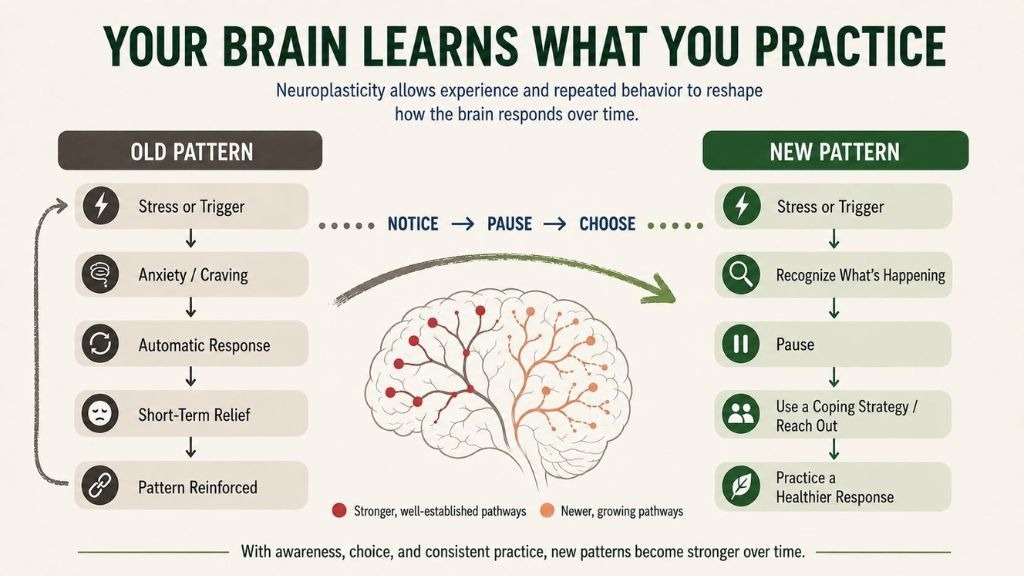
Your Brain Learns What You Practice
Think about the algorithm behind YouTube, TikTok, Instagram, or another social media platform. If you repeatedly watch the same kinds of videos, search for the same subjects, and click similar posts, the algorithm notices. Before long, your feed gives you more and more of what you have been feeding it.
Suppose you decide you don’t like what your feed has become. You stop clicking certain material. You might clear your history, search for different subjects, and deliberately engage with different content. The feed doesn’t transform instantly, but over time your actions begin changing what appears.
Your brain is vastly more complicated than a social media algorithm, so the comparison isn’t literal. But it illustrates something important:
Your brain learns what you practice.
Neuroplasticity means the adult brain is dynamic rather than permanently fixed. Learning and experience can alter neural connections and the way networks operate. When we repeatedly practice a response, we give the brain more experience with that response.
In that limited sense, you really can talk about “reprogramming” or “rewiring” your brain—as long as we understand those words as metaphors for learning and biological adaptation, not as though the brain were a computer with software we can simply rewrite.
What Synaptic Pruning Has to Do With It
You may have heard the phrase “use it or lose it.” There is some truth behind the idea, but the biology requires more care.
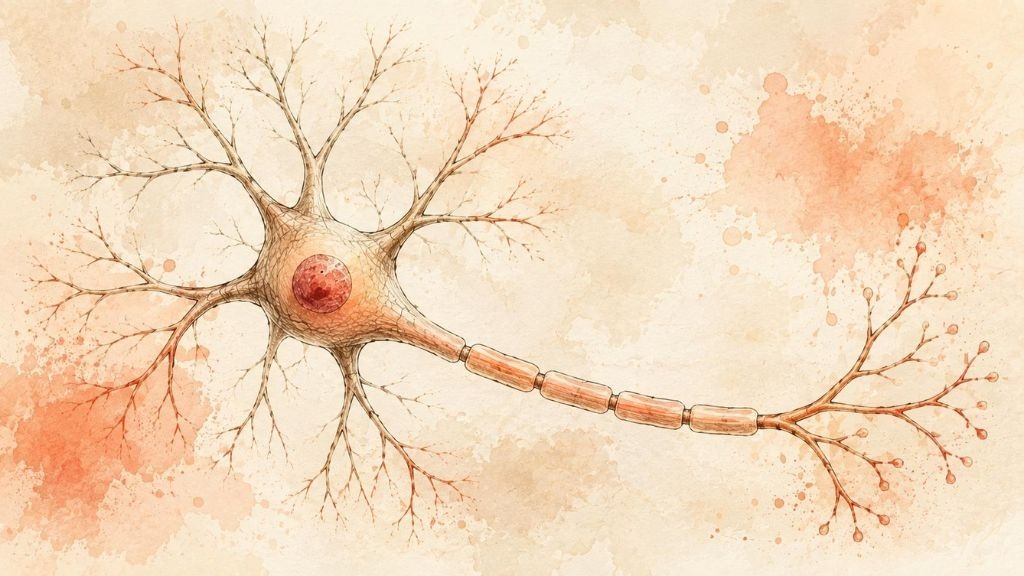
The nervous system is constantly remodeling itself. Synapses—the connections through which neurons communicate—can become stronger or weaker, and some can eventually be eliminated. Synaptic pruning is particularly important during brain development, although structural and synaptic plasticity also continue in adulthood.
That doesn’t mean refusing a cigarette ten times causes the brain to “delete” smoking, or that an unwanted memory simply disappears because you stop thinking about it. Instead, it gives us another reason why repetition matters. An established pattern usually took time to develop. A healthier alternative needs time and practice too.
Why Reward Makes Some Patterns So Powerful
Dopamine is sometimes described as the brain’s “pleasure chemical,” but that is too simple. Dopamine is importantly involved in learning, motivation, reinforcement, and signaling that something deserves attention. Drugs can strongly engage these systems, helping connect substance use with people, places, emotions, and other cues.
Consider this sequence:
Stress → alcohol or drug use → temporary relief → reinforcement → greater likelihood of using again
Similar learning principles can contribute to repeated smoking, overeating, pornography use, gaming, or compulsive scrolling, although these behaviors should not all be treated as medically identical to substance addiction.
Past experience also helps shape expectations. The brain uses previous information to anticipate what may happen and prepare responses. If anxiety has repeatedly been followed by substance use, the arrival of anxiety itself may eventually begin calling up the familiar response before you’ve consciously decided what to do. Predictive-processing research describes this broader role of prior experience and expectations in perception and action.
What Neural Repatterning Actually Looks Like
Neural repatterning isn’t a magic switch or a single standardized medical treatment. Here, we’re using the term in a practical sense: recognizing an established response, interrupting it, and repeatedly practicing something healthier.
An old pattern might look like:
Stress → anxiety → craving → substance use → temporary relief
The pattern you’re trying to practice might be:
Stress → recognize anxiety → pause → name what is happening → contact someone → use a coping strategy → don’t use → allow the urge to pass
At first, the second sequence may feel awkward and extremely uncomfortable. That’s understandable. The old response has experience behind it; the new one doesn’t.
Something feeling unfamiliar does not mean it isn’t working.
How to Start Training Your Brain Differently
Start by noticing your triggers. Pay attention to what happens immediately before the behavior: anxiety, anger, boredom, rejection, loneliness, certain people, certain places, or even a particular time of day.
Next, create a pause. You don’t have to solve anything during that pause. You’re simply putting some space between the urge and the automatic response.
Then name what is happening: I’m anxious. I’m angry. I’m craving. I feel rejected. I’m bored. I want relief. Literally verbalizing this can be helpful. Putting words around the experience can help move you from simply reacting toward noticing that a choice is approaching.
Most importantly, have a specific alternative ready. “Don’t do it” leaves an empty space. Fill that space with something: take a walk, exercise, call someone, attend a recovery meeting, use a grounding technique, journal, leave a high-risk environment, or use a coping skill you’ve practiced in counseling.
Change your environment when you can. Remove alcohol from the house. Block access to websites that repeatedly pull you back into unwanted behavior. Change a routine associated with using. Spend more time with people who support what you’re trying to become.
Then repeat.
One different choice matters. Twenty different choices give the new response more practice. And remember that the things you repeatedly allow into your mind, your environment, and your daily life help shape the person you are becoming. Pay attention to:
- What you think about
- What you see
- What you read
- What you hear
- Who you spend your time with
- What you spend your time doing
All of these influence you. Over time, repeated choices and repeated exposure can either reinforce the patterns you’re trying to leave behind or strengthen the new ones you’re trying to build.

Why Willpower Is Often Not Enough
If determination by itself were enough, many people would have stopped long ago.
This becomes especially important with substance use disorder. Addiction involves biological, psychological, and social factors, and evidence-based treatment may involve medical care, counseling, peer support, recovery communities, and medication. Treatment can help people regain control over lives disrupted by addiction.
For opioid use disorder, a medication such as buprenorphine is an evidence-based treatment option. Medication-Assisted Treatment (MAT)—also increasingly described as medications for opioid use disorder—can provide stability while someone works on the behavioral, emotional, relational, and practical parts of recovery. Buprenorphine, including formulations containing buprenorphine and naloxone such as Suboxone, can reduce withdrawal symptoms and cravings when appropriately prescribed.
An addiction doctor or other healthcare professional experienced in recovery, along with a counselor, Certified Peer Recovery Specialist, support group, trusted friend, or family member, can become part of the structure supporting change.
Community matters because isolation leaves you alone with an established pattern. Other people can provide accountability, encouragement, perspective, and practical help when your own thinking starts steering you toward the familiar route.
A Few Things to Remember
- You are not going to change your entire life in one day.
- New patterns require repetition.
- Difficulty doesn’t automatically mean failure.
- A setback doesn’t erase what you have already learned.
- Learn from setbacks instead of treating them as proof that change is impossible.
- Be patient with yourself while still taking responsibility for your choices.
- Ask for help before you become overwhelmed.
- Lasting change is usually built through many small decisions, not one dramatic moment.
You Can Practice Something Different
Your brain learns what you practice.
You cannot instantly erase years of learned behavior, and neuroplasticity does not mean change will always be easy. What it means is that the struggle isn’t necessarily permanent. Every time you recognize an old pattern and deliberately practice a healthier response, you are doing something meaningful.
Understanding neuroplasticity doesn’t remove the work involved in changing your life. It helps explain why that work can matter.
Ready to Get Help?
If substance use disorder is one of the patterns you’re trying to change, you don’t have to rely on willpower alone. Reach Recovery and Integrated Health in Asheville, North Carolina, provides evidence-based addiction treatment that includes personalized medical care, Medication-Assisted Treatment including Suboxone when appropriate, intentional recovery education, and access to Certified Peer Recovery Specialist support.
Disclaimer: This article is for informational purposes only and should not be considered medical advice, diagnosis, or treatment. Anxiety, withdrawal symptoms, and substance use disorders should be evaluated by qualified healthcare professionals. Some withdrawal syndromes may require medical supervision.